
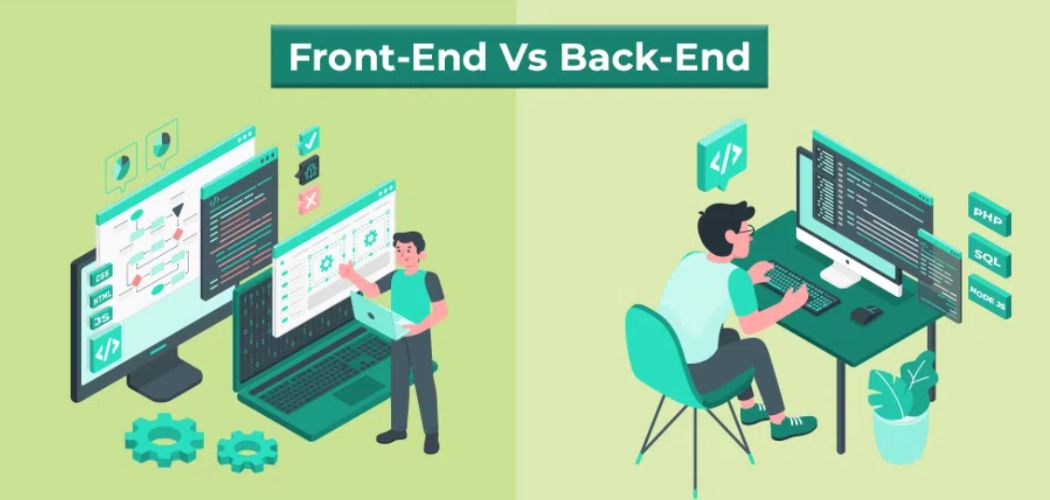
Web development is the foundation of every website and web application we use today. From a basic business website to advanced web platforms, everything is created through a combination of design, code, and functionality. This process is mainly divided into two core areas: front-end development and back-end development. Although they work closely together, their roles and responsibilities are very different.
Understanding the difference between front-end and back-end development is important for business owners planning a website, students considering a career in technology, and anyone curious about how websites actually work. In this blog, Logixwebtech breaks down front-end vs back-end development in detail, explaining their roles, technologies, required skills, career paths, and how both sides collaborate to build powerful, high-performing websites.

What Is Front-End Development?
Front-end development focuses on everything users see and interact with on a website or application. It is also known as client-side development because it runs in the user’s browser.
When you open a website and notice the layout, colors, fonts, buttons, animations, images, or navigation menu, you are experiencing the work of a front-end developer. Their goal is to create an interface that is visually appealing, user-friendly, responsive, and accessible across devices.
Common Front-End Technologies
✔ HTML – Provides the basic structure of a webpage, defining elements like headings, paragraphs, images, and links.
✔ CSS – Controls the visual presentation, including colors, fonts, layouts, responsiveness, and smooth animations.
✔ JavaScript – Adds interactivity and dynamic behavior such as form validation, sliders, pop-ups, and real-time updates.
✔ Frameworks & Libraries – Tools like React, Angular, Vue.js, Bootstrap, and Tailwind CSS help developers build scalable, responsive, and performance-optimized user interfaces faster.
Front-end developers combine creativity with strong technical skills to create visually appealing and user-friendly experiences. They work closely with UI/UX designers to convert design concepts and wireframes into fully functional, responsive, and accessible interfaces that work seamlessly across different devices and browsers.

What Is Back-End Development?
Back-end development focuses on the server-side of a website or application. It handles everything that works behind the scenes to ensure that the front end functions smoothly. While users never directly see the back end, it is responsible for processing requests, managing data, and delivering the correct information to the user interface.
Whenever a user logs in, submits a form, places an order, or retrieves data from a website, the back-end system is working in the background. The main goal of back-end development is to create secure, scalable, and efficient systems that support front-end functionality.
Common Back-End Technologies
✔ Server-Side Programming Languages: Languages like PHP, Python, Java, Ruby, and Node.js handle application logic and process user requests on the server.
✔ Databases: MySQL, PostgreSQL, MongoDB, and SQL Server are used to store, manage, and retrieve user data, content, and transactions.
✔ APIs (Application Programming Interfaces): APIs connect the front end with the back end, enabling smooth data exchange and third-party integrations.
✔ Servers & Hosting Environments: Servers and cloud platforms manage application performance, deployment, uptime, and scalability.
Back-end developers focus on logic, performance, and security. They ensure that applications run reliably, data is protected, and systems can scale as user demand grows. By working closely with front-end developers, they help create complete, high-performing digital products.

What's the Difference Between Front-End vs. Back-End?
Front-end and back-end development serve different but complementary roles in application development. While one focuses on user interaction and visual design, the other manages data processing, system logic, and performance behind the scenes.
|
Aspect |
Front-End Development |
Back-End Development |
|
Focus |
User-facing interface and interactions |
Server-side logic and application functionality |
|
Visibility |
Visible to users in browsers or apps |
Operates behind the scenes |
|
Primary Role |
Enhances usability, design, and responsiveness |
Manages data, logic, and performance |
|
Core Technologies |
HTML, CSS, JavaScript |
Python, Java, PHP, Node.js |
|
Frameworks |
React, Angular, Vue.js |
Django, Spring Boot, Laravel |
|
Data Handling |
Accesses data via APIs |
Directly manages databases |
|
Performance Focus |
Speed, layout, responsiveness |
Scalability, security, efficiency |
|
Security Role |
Client-side validation |
Authentication, authorization, data protection |
Related Article:
Native vs Hybrid App Development: Which Is Better for Your Business?
Common Website Development Mistakes and How to Sidestep Them
How Mobile Apps Help Businesses Grow

Which is More Important: Frontend or Backend?
Neither front-end nor back-end development is more important than the other; both are equally essential for a successful website or application. The front end determines how users experience and interact with a platform, while the back end ensures data accuracy, security, and performance. A visually appealing website without a strong back end will fail to function properly, just as a powerful back end without a user-friendly interface will struggle to engage users. Effective web development relies on the seamless integration of both disciplines working together.